4-Week At-Home Workout Plan: Daily Routines + Stretches
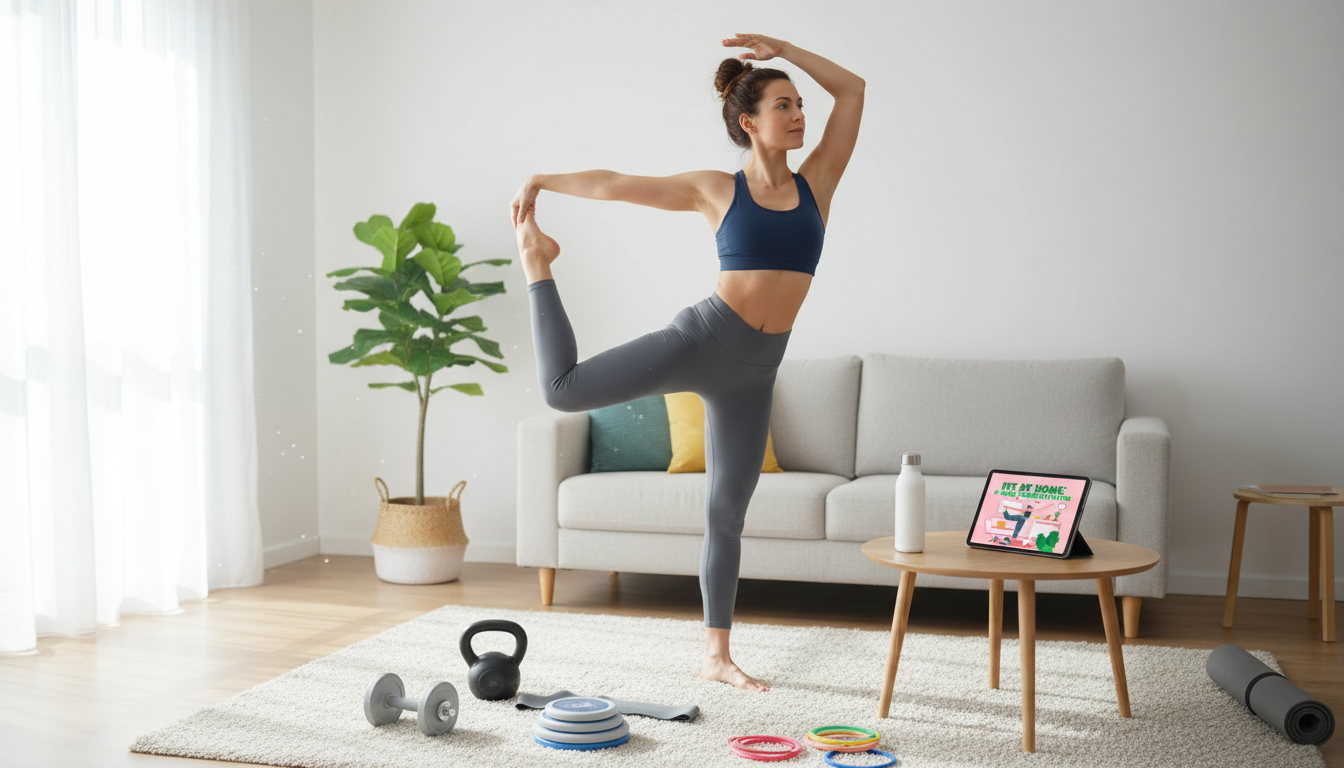
Fit at Home: 4-Week Workout Plan With Minimal Equipment (Daily Workouts + Stretches)
Consistency gets easier when the plan is already decided. This 4-week at-home routine is built around short daily sessions, simple progressions, and a repeatable warm-up and stretch sequence—so workouts fit real schedules and small spaces. Expect a mix of strength, low-impact conditioning, core training, and mobility work, with room to scale each day up or down. For more guidance, see [PDF] No Equipment Home Workouts: strength workouts – UT RecSports.
Who This Plan Fits Best
- Beginners returning to exercise who want a clear day-by-day roadmap
- Busy adults who prefer shorter sessions over long gym workouts
- Home exercisers with limited space and minimal equipment
- Anyone who benefits from a built-in warm-up, workout, and cooldown stretch sequence
- People who want steady progress over 4 weeks without guesswork
What “Minimal Equipment” Can Mean at Home
- No-equipment options: bodyweight strength, cardio intervals, mobility, and core work
- Helpful add-ons (optional): a resistance band, a pair of light-to-moderate dumbbells, a mat, a chair/bench, and a timer
- Space needs: roughly a yoga-mat area plus room to step forward/back
- Quiet-friendly swaps: marching high knees instead of jumping, step-backs instead of burpees
- How to choose resistance: end each set with 1–3 reps left in the tank to keep form clean
For general fitness, the CDC’s weekly activity guidelines are a useful benchmark, and the ACSM’s resistance training recommendations align well with progressive, full-body home routines. For further reading, see [PDF] HOME WORKOUT PLAN.
How the 4 Weeks Are Structured (Progress Without Overwhelm)
- Week 1: Foundation — learn movement patterns, establish consistency, prioritize form
- Week 2: Volume — slightly more total work (extra set, longer interval, or reduced rest)
- Week 3: Intensity — harder variations, controlled tempo, or heavier resistance if available
- Week 4: Consolidation — repeat your strongest week with cleaner execution and better pacing
- Daily flow suggestion: 5–8 min warm-up → 15–30 min workout → 5–10 min stretches
- Recovery counts: lighter days still build momentum and keep joints feeling better
A practical way to keep progress steady: pick one improvement per week—either a small bump in reps, a slightly harder variation, or 10–20 seconds less rest. Keeping everything else the same makes it obvious what’s working.
Weekly Overview at a Glance
Use this as the weekly rhythm. The exercises can rotate, but the pattern stays familiar. If soreness is high, swap one conditioning day for mobility plus an easy walk.
| Day | Focus | Workout Style | Cooldown Stretches |
|---|---|---|---|
| Day 1 | Full-body strength | Squat/hinge/push/pull + core (circuit or straight sets) | Hips, chest/shoulders, hamstrings |
| Day 2 | Low-impact conditioning | Intervals (marching, step-outs, shadow boxing, brisk walk) | Calves, hip flexors, gentle spine rotation |
| Day 3 | Lower-body + core | Glutes/legs focus + anti-rotation/brace work | Glutes, quads, hip flexors |
| Day 4 | Mobility + recovery | Short mobility flow + easy movement (walk or light cycle) | Full-body stretch sequence |
| Day 5 | Upper-body + core | Push/pull emphasis + posture work | Lats, pecs, upper back/neck |
| Day 6 | Full-body conditioning | EMOM/AMRAP style (scaled to ability) or steady-state cardio | Hips, hamstrings, ankles |
| Day 7 | Rest / reset | Rest day or gentle stretching only | Relaxed breathing + light mobility |
How to Scale Each Workout (Beginner to Intermediate)
- Make it easier: reduce range of motion, slow down, add rest, use a chair for support, or swap jumping for stepping
- Make it harder: add a set, reduce rest by 10–20 seconds, increase load, or use slower tempo (e.g., 3 seconds down)
- Simple progression rule: change only one variable at a time (volume OR intensity OR density)
- Form-first checkpoints: neutral spine on hinges, knees track over toes on squats/lunges, ribs down during core work
- Stop signs: sharp pain, numbness/tingling, or dizziness—switch to gentle mobility or consult a professional
Daily Stretches That Match Home Training
Post-workout stretching is less about “forcing flexibility” and more about reducing stiffness so the next session feels smoother. Keep it simple and repeatable.
- Lower-body staples: hip flexor stretch, hamstring stretch, glute stretch, calf stretch
- Upper-body staples: chest doorway stretch, lat stretch, thoracic opener
- Breathing cue: inhale through the nose, long exhale to help muscles release tension
- Time-efficient approach: choose 4–6 stretches and hold each 20–40 seconds
Getting the Most Out of the PDF eBook
Product Option: Fit at Home 4-Week Workout Plan (PDF)
If a ready-to-follow structure helps workouts happen more often, the Fit at Home: 4-Week Workout Plan (PDF) is designed for day-by-day use, with minimal-equipment workouts and guided stretches. It’s especially useful for apartment-friendly, low-noise substitutions and for anyone who wants a clear start and finish date.
To support recovery and consistency on the mental side, consider pairing training days with brief relaxation sessions from Calm Your Mind: Guided Meditation Series or a quick reset like 5-Minute Reset for Exhausted Parents (3 in 1).
FAQ
How long should each daily workout take?
Most days land around 20–45 minutes including a short warm-up and cooldown stretches. On busy days, do 10–15 minutes of the main circuit and finish with a quick 2–4 minute stretch to keep the habit intact.
Is this plan suitable for beginners with no equipment?
Yes—bodyweight options work well when scaled appropriately. Use stepping instead of jumping, incline push-ups on a counter, and chair-assisted squats as needed, and take longer rests in Week 1 while focusing on smooth, controlled form.
What if soreness is high in the first week?
Mild-to-moderate soreness is common when restarting, but sharp pain isn’t. Swap a hard day for mobility plus easy walking, prioritize sleep and hydration, and return to the next session at a slightly lower intensity or with simpler variations.











Leave a comment